What Hanford's Age of Housing Means for Your Garage Door
Most Hanford homes were built 1974-2003, and severe summer heat stresses garage door springs and openers. Here's what that means for repair costs here.
Most houses in Hanford's service area went up between 1974 and 2003, with the median right around 1982. That 1980s-and-90s stock spans 13 named communities in the area, from Armona three miles out to Tulare twenty miles east. A lot of that means the same builder-grade torsion springs, the same steel roll-formed doors, the same basic chain or belt openers installed once and left alone for decades.
Hanford sits in a climate band the codes rate as severe heat, which is hard on torsion springs and opener boards alike. Heat doesn't announce itself like cold does with a snapped cable on a January morning. It works slower, drying out the lubricant in a spring's coils, cooking the grease inside an opener gearbox, and cycling steel doors through expansion and contraction every single day the garage sits closed under a hot roof. A spring rated for a certain number of cycles in a mild climate loses cycles faster here.
The practical result is that a door installed in 1985 and never touched since is carrying more fatigue than its age on paper suggests. Panels can bow slightly at the seams from repeated heat expansion, and openers that would run another five years in a cooler climate start throwing intermittent faults instead. None of this shows up until the door won't open one afternoon, usually the hottest one of the week.
The Common Mistake
The mistake we see most is treating a garage door like it doesn't need attention until it stops working. On a door installed during that 1974-2003 building run, the spring and the opener are both original more often than not, and both have already absorbed years of heat cycling most owners never think about.
A second version of the same mistake is lubricating with whatever's on the shelf. Heavy grease in a hot garage picks up dust and grit off the floor and turns gummy inside the coils, which speeds up wear instead of slowing it. A light, dry-type lubricant made for garage door springs holds up better here than the all-purpose can most people reach for.
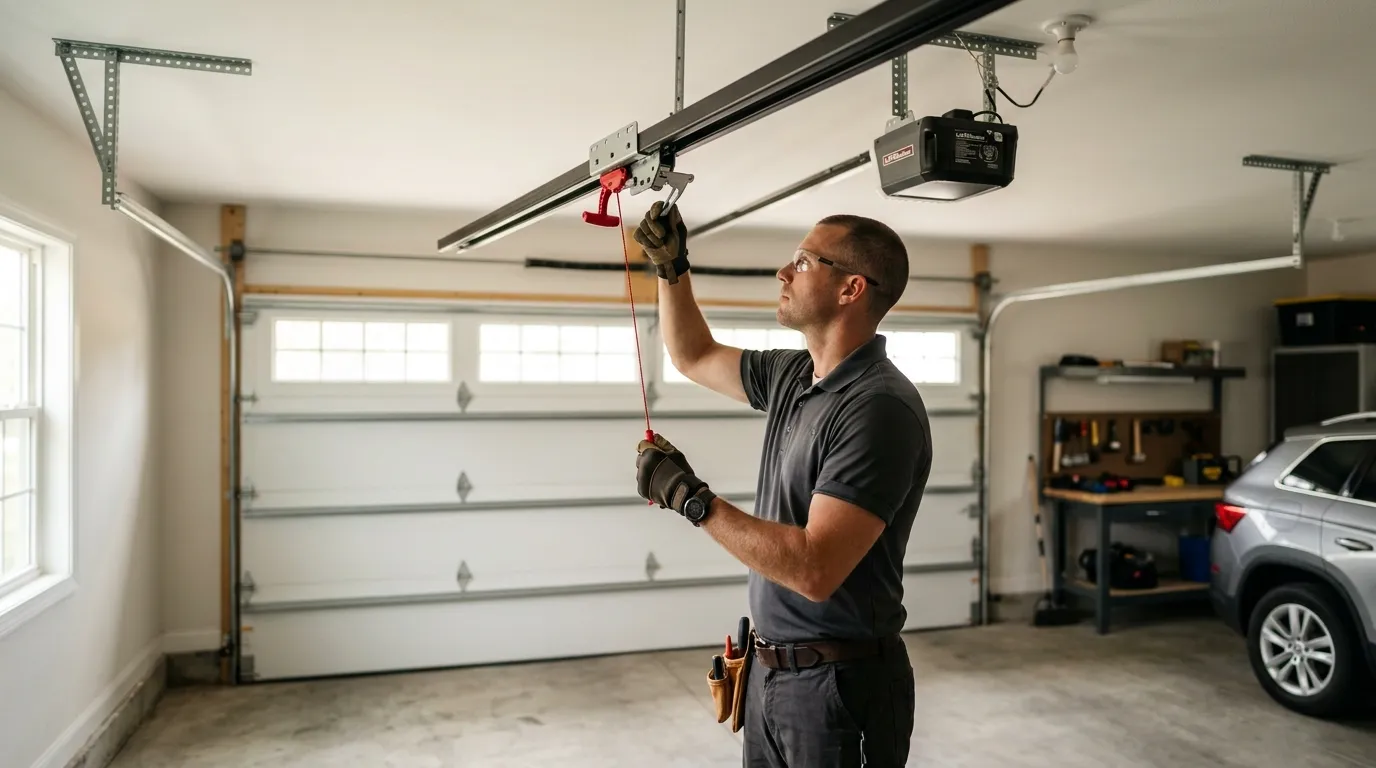
The third mistake is skipping the balance check. Disconnect the opener, lift the door by hand halfway, and let go. It should hold. If it drops or shoots up, the spring's tension is off, and running the opener against that imbalance for another six months burns out the motor faster than the heat alone would. On a house from this era, that's an original opener doing work it wasn't built to keep doing, and it's usually cheaper to catch the spring problem than to replace the opener that failed trying to compensate for it.
What You Pay
There's no flat number we can hand out here, because what a job costs depends on what's actually failed and how old the hardware is, and we're not going to pretend otherwise with a price we can't back up. A worn torsion spring on a 1980s door is a different job than a full opener swap, and a door with expired parts availability is a different conversation than one where the spring size is still common.
With a median household income of $65,781 here, most owners want a straight answer on what a spring or opener replacement costs before they commit, and that's a fair ask. What we can tell you honestly is that we won't quote a number over the phone without seeing the door - the age of the spring, the condition of the tracks, whether the opener is original to the house - all change the math. If a repair would cost close to what a comparable new setup runs, we'll say so plainly rather than sell a patch job on hardware that's near the end of its life.
The one thing worth planning for: on original hardware from this housing era, parts for older opener models can take longer to source than the repair itself. That's the honest limitation - sometimes the wait on a part is longer than the wait on us.
The Situation
Across the service area's 51,462 households, 23,164 are owner-occupied houses carrying doors from that same building era, which is a big share of garage doors all aging on roughly the same clock. That's the reason spring failures tend to cluster the way they do here - not one bad batch, just a lot of hardware installed in the same 20-year window now hitting the same wear point at close to the same time.
We cover Hanford and the towns around it - Armona just three miles off, Laton and Lemoore both around eight, out to Traver and Goshen at 13, Riverdale and Kingsburg at 14, Lemoore Station and Waukena at 15, Selma at 17, and Corcoran, Caruthers, and Tulare at 18 to 20 miles. Housing stock and heat exposure are similar across that whole stretch, which is why the same set of failure points - fatigued springs, tired opener boards, gritty old grease - shows up on service calls no matter which of those towns the call comes from.
If your door is acting up and the house was built anywhere in that 1974-2003 window, the odds are decent it's original hardware finally catching up to it, not something you did wrong.
How it works
From “it’s stuck” to “it’s fixed”
01
Tell us what’s wrong
Describe the symptom - won’t open, loud bang, opener runs but the door won’t move.
02
On-site diagnosis
A technician tests the door under power and by hand and finds what actually failed.
03
Clear, up-front plan
You get the fix that’s needed and what drives the cost - before any work starts.
04
Repaired & tested
The repair is done, the door is set true and tested, and the work area left clean.
Serving Hanford, CA - tell us what your door’s doing and we’ll take it from there.
Why does my garage door spring keep breaking in the summer here?
Heat dries out the lubricant inside a torsion spring's coils faster than a mild climate would, and Hanford sits in a severe-heat band. A spring that's already 20-30 years old, common on houses built in that 1974-2003 window, has less life left in it and heat pushes it past the edge sooner than the calendar alone would suggest.
Is my opener too old to be worth fixing?
Depends on the model and what's actually failed. An opener original to a house built in the 1980s or 90s has likely done more work than its age implies, given the heat cycling here. We check the gearbox and board condition before we tell you whether a repair makes sense or whether you're better off replacing it outright.
How do I know if my door's spring tension is off?
Disconnect the opener, lift the door by hand to about halfway, and let go. A properly balanced door holds its position. If it drops or jumps up on its own, the spring tension is wrong, and running the opener against that imbalance wears the motor out faster than normal use would.
Do you give a price over the phone?
No, and we won't pretend to. Spring size, opener age, and parts availability all change what a job costs, especially on original hardware from an older house. We look at the door first and give you a real number, not a guess that changes once we're there.
Ready to get your garage door sorted?
Tell us what it’s doing and where you are in Hanford - we’ll take it from there.